Showing posts with label memória. Show all posts

Monday, 30 August 2010

Cinema São Luiz

fotos do site kinoplex e posts do fotolog http://fotolog.terra.com.br/luizd:1924
O projeto deste cinema foi do arquiteto Jaime Fonseca Rodrigues e sua arquitetura interna foi inspirada no Radio City Music Hall, de Nova York.

Chegou a ter 2002 lugares em 1945, e foi demolido em 06/01/1980, quando foi desapropriado para a passagem do Metrô.

Esta última informação foi comentada, num dos "posts" anteriores por L. H. Neto da seguinte maneira:

"O cinema não foi demolido em 1980 para o Metrô. O que foi demolido foi o magnífico salão de entrada. A sala de exibição ficou incólume, assim como as escadas. Durante as obras do metrô a entrada pela rua do Catete foi fechada e se entrava pela "lateral" do "hall", pela rua Machado de Assis, por uma portinha discreta. Eu ia muito ao São Luiz por essa entrada na Machado de Assis, já que minha namorada da época morava nessa rua. Anos depois o cinema aí sim foi demolido para ser construído aquele shopping que está lá até hoje e em seu lugar os novos cinemas São Luiz que também estão lá até hoje".

Em 16/11/2009, às 12:31:23, Etiel | e-mail disse:

O São Luiz me faz recordar um Largo do Machado que conheci em tempos de adolescência e solteirice. O Lamas, com seu filé à francesa, as frutas na entrada e o salão de sinuca nos fundos.
Em 28/02/2008, às 11:35:32, lyscia disse:
Quando criança adorava esse cinema,sempre acompanhado de um saquinho de bala toffee.

Em 16/11/2009, às 07:14:24, Candeias disse:
O belo registro não dá idéía de com era grande o cinema. Se não me engano tinha três níveis para a platéia, com assentos confortáveis e ótimo som. O primeiro filme que vi ali foi Captain Horatio Hornblower (não me lembro do título traduzido), com Gregory Peck e Virginia Mayo.

Em 28/02/2008, às 01:21:21, Cristina disse:
Lembro muito bem da fachada, mas do hall, suntuoso como nas fotos, não tenho lembrança. Lembro, sim, de como era grandioso.
Á esquerda ficava o Lamas. Ótima pedida para a saída do cinema.
Curiosidade: o Lamas, também demolido para a passagem do metrô, criou um filé - "filé a metrô", um bife que é perfurado por um túnel de presunto.

Saturday, 1 May 2010

Bipbip


Via Fernanda Bruno, cartoon- vigilante em ritmo de ACME

Monday, 30 November 2009

refletindo sobre corte-seco II

Aviso aos navegantes do Corte Seco:
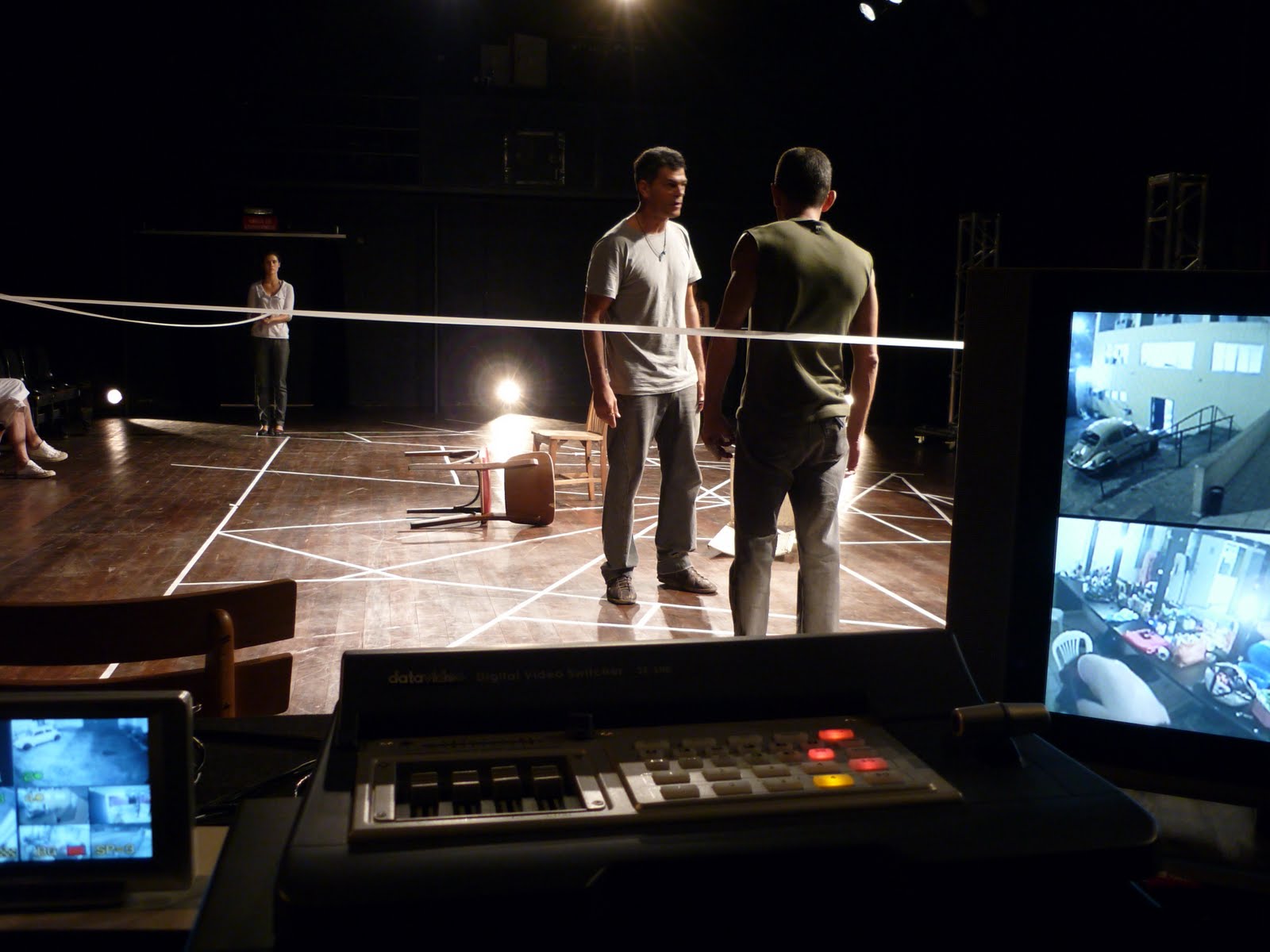
As imagens exibidas nas telas em cena não são pré-gravadas.
Elas estão sendo captadas, ao vivo, durante o espetáculo.
A bem da verdade imagens estão sendo captadas o tempo todo, em nossos elevadores, estacionamentos, espaços públicos e privados. As pessoas vivem sob a mira de cameras 24h/dia, mas estão completamente esquecidas disto. Meu trabalho com imagens desta natureza tem consistido precisamente em apontar para esta presença ostensiva, e propor uma apropriação artística destes dispositivos.
Para o espetáculo de Chris Jatahy, desenvolvi um circuito fechado de vídeo, que foi instalado no Espaço Sergio Porto, sob a minha coordenação. Até o final de dezembro eu mesma estarei operando este circuito em cena.
A despeito de todas as evidências, me disseram que os espectadores da peça de teatro resistem a crer que as imagens sejam produzidas em tempo real. Achei este dado interessante, e a meu ver totalmente pertinente dentro da proposta do espetáculo, que pretende borrar fronteiras entre realidade e ficção. Mas me pergunto: a que se poderia atribuir esta descrença? Será que para estes espectadores, educados audiovisualmente pelo cinema, a imagem seria tomada como um artefato produzido para um efeito ficcional, necessariamente em um momento anterior aquele em que a assistimos? Seria por isto talvez que o público resistiria a tomá-la em sua imediatez automática? Mas e a televisão? Já não teria modificado, com suas entradas ao vivo, esta relação de tempo com a imagem?
Conclusão possível: o público acredita naquilo que quer. Não se pode forçá-lo a crer que sim, as imagens estão sendo geradas naquele preciso momento. Eu particularmente incluiria sim momentos pré-gravados, a fim de tornar as zonas de indiscernibilidade ainda mais complexas, mas Christianne prefere tomar a direção oposta. Para isto penso que podemos trabalhar mais no sentido de expandir as encenações para os espaços televisionados, colocando-os em maior diálogo e maior tensão com o que acontece em cena. Investir na contiguidade entre o espaço do palco e os anexos videovigiados - venho apontando para esta necessidade há algum tempo. Jogar mais com os monitores em cena - atribuir-lhes os verbos das cadeiras, por exemplo. Mas sei que são muitos detalhes a serem ajustados, e espero que nesta próxima etapa, agora que já estreamos, a presença do vídeo em cena possa ser afinada, aprimorada e melhor aproveitada.

Thursday, 2 July 2009

work in progress

composition for cctv during dance on focus festival - rio de janeiro 2009
workshop by paola barreto

the workshop will take place on the second weekend of july

first i will present a selection of different works on video, performance, film, theater and dance that explores surveillance images through different art dispositifs (luksch, teran, viola, nauman, calle, graham, paik, etc.) the idea is to place my proposal in a context of contemporary art and academic discussion.

on the second half, we will organize the ideas and concepts raised during the analisys of the works presented: insecurity, fear, terrosism, melancholia, voyeurism, attention, suspicion, stereotypes, curiosity, doubt, fact&fiction and others (i need some time to organize it better, hope i'll get it in paraty!)

on the second day of the workshop we we will develop a partiture and a grammar of moves, actions and behaviors over wich we could develop a choreography for spaces under surveillance.

horizon is more clear. (i hope)

Sunday, 13 July 2008

Integral


Pensando em imagens criadas não por meio de dispositivos óticos como câmeras e lentes, mas via sensores de temperatura, densidade, peso, ondulação, radio frequência. Uma outra forma de lidar com a produção de filmes, que prescinde do 'olhar' 'ocular', ampliando a noção de 'perspectiva ocular' para uma de 'campo presencial'. pesquisando para isso topo em coisas como um espaço hertziano.

Friday, 11 July 2008

Dziga Vertov


“Eu sou um cine-olho. Eu sou um construtor.
Eu te coloquei num espaço extraordinário
que não existia até este momento.
Nesse espaço tem doze paredes
que eu registrei em diversas partes do mundo.
Justapondo a visão dessas paredes e alguns detalhes
consegui dispô-las numa ordem que te agrada e edifiquei,
da forma adequada, sobre os intervalos,
uma cine-frase que é, justamente, esse espaço.

Eu, cine-olho, crio um homem muito mais perfeito
que aquele que criou Adão, crio milhares de homens
diferentes segundo desenhos distintos
e esquemas pré-estabelecidos.

Eu sou o cine-olho.

Tomo os braços de um, mais fortes e hábeis,
tomo as pernas de outro, melhor construídas e mais velozes,
a cabeça de um terceiro, mais bonita e expressiva e,
pela montagem, crio um homem novo, um homem perfeito.”


Tuesday, 24 June 2008

Mulheres que eu amo 3

Interview with Michele Teran (September 2005)

servus:
Misha, I have met you in the context of various electronic art festivals which mostly take place in technologically highly developed countries. If I look at your website you seem to be permanently productive and on the road? Is it important for your work to travel so much? Why is this?

misha:
Since 2001, my practice as a performance/live artist has become increasingly location-based. I am exploring the technological (communication) systems within urban environments and how they are embedded within the everyday. My creative output involves performative interventions using media spaces such as public webcams, WLAN hotspots and wireless CCTV. The creation and existence of these media spaces have social, cultural, geographical and political significances that I examine and expose. By moving from city to city, so far within North America, Australia and Europe, I am interested in exploring how these spaces are interconnected through common issues/concerns like privacy, borders and marginality or shared social rituals and codes, but are at the same time existing within local contexts, each with their uniqueness.

servus:
Most of the artists and cultural producers I know are living under "unstable" life conditions. What are your personal experiences with this lack of stability and does this fact go together with the theory of normadism within the context of art?

misha:
Making art is generally an unstable business. One must deal with the instability of an idea, the sustainability of interest in the artist's vision, creating optimum conditions for producing a work, financial support, maintaining personal and professional relationships, the difficulty of collaborations, etc. I think that these challenges are always present if not an important part of what it means to be active within an artistic practice.

In terms of nomadism, I recently saw "The Gleaners and I", a documentary by Agnès Varda about urban and rural gleaning practices in France. 'To glean' means to gather after the harvest, to collect bit by bit. By asking people common questions about the practice of gleaning she also 'gleans' information about that person's life, making connections between the different stories, only made possible through the process of moving amongst people and spaces. At one point she refers to her own practice as a filmmaker, herself a gleaner through her digital camera, stating 'It's what I have gleaned that tells me where I've been', reflecting on the importance of travels between ideas, objects, places and experiences to developing her reality, but also opening herself up to change with the input of new things. This is the way many artists work. They glean information; make connections and conclusions, which also change through time and experience. This defines a nomadic state, which does not require a literal act of traveling.

servus:
Back to your work as performance/live artist. One of your continuing work is to intercept wireless observation cams in different cities and show the results in different setups on the street and also art spaces? Your are using the aesthetics of a traveler carrying a suitcase with a built in monitor or the aesthetics of a homeless.

What are the reactions of the passers-by? And could it be also be understood as a personal way of resistance against observation? What do you think about how privacy is vanishing?

misha:
Discussions concerning surveillance very often turn to the Foucauldian model of the Panopticon and the loss of privacy of the individual. While I acknowledge this view, I am more interested in examining the situation of borders and the anxiety induced through fear of those thresholds being crossed, of which loss of privacy is an effect. On a wider level, one can observe a growing level of fear of the 'other', which can be evidenced in border and immigration issues, feelings of instability over homogenous national identity especially within Europe, gated communities with the United States, Homeland Security and terrorism. This feeling of insecurity trickles down to the private citizen. At the same time there is a surplus of inexpensive, easy-to-use surveillance technologies for the average consumer. My particular focus is on wireless surveillance cameras found in stores where you might also buy a DVD player. The cameras transmit on the 2.4 Ghz ISM band, a narrow part of the electromagnetic spectrum allocated for public use. This means you can legally operate one of these cameras without having to acquire a broadcasting license. So suddenly you have a number of individuals broadcasting and contributing to an invisible network of media within our urban environments.

People place cameras on what they feel need protection. The different views, an unmade bed, a baby's crib, a hallway, cash machine, restaurant kitchen, doorway, storage room, café table, gate or sidewalk, illustrate a diverse landscape of perceived insecure areas and reveal something about the camera's owner. The wireless transmitters are also used to distribute television to another room, so that you don't have to lay down cables. Because of this I can also pick up television signals, and observe what people are watching. The culmination of these acts creates for me an intriguing narrative space of the neighbourhood and of the city itself.

I can also talk about the qualities of the wireless signal and radio propagation in relation to urban environments. Wireless video transmissions extend past set boundaries of the rooms they are intended for and out onto the street. This makes a private encounter public, but also challenges conventions such as inside/outside or public/private. Am I entering the space or is the space entering me?

During the street performances, the audience is led on a journey through the city, guided through a series of hidden views by an urban and nomadic persona, who acts as a physical interface to the unseen. The female character is characterized by her mobility and embodies the qualities of the wireless signal. These personae allude to the metaphoric power of wandering and also people's puzzlement and even fear towards those that live beyond walls, through choice or circumstance. The audience, led on this nomadic journey, is drawn into a borderline action of observing a normally unseen and ephemeral view of public and private space. Staged as a silent 'mise-en-scéne' which no offer of explanation, the audience participates in the production of meaning through their observation and interpretation. The result is a multi-layered reading of what is happening and what they are seeing, an experience that is, according to feedback from previous performances, disorienting, mesmerizing, humorous and even terrifying.

servus:
This year you got a honorary mention for 'interactive art´ at the ars electronica. What was your first reaction? What are your expectations?

misha:
It took me long time to consider this project an artwork. I made my first discovery in 2002, explored it more in depth for a year understanding why it was so interesting for me, besides the novelty of being to do it at all. So my first reaction was that perhaps it was okay to meander a bit and let things evolve. This brings me back to Varda's statement about knowing where you are by retracing where you have been. Afterwards I was excited because I do consider it a privilege. I try not to come in with too many expectations because I end up feeling disappointed. I expect to put every effort into making a good performance. I expect to be surprised. I expect to adjust accordingly. But apart from that I open myself up to the city of Linz and what it has to tell me.

servus: Congratulations and thank you for the interview.

///////////////////////////////////////////////////////////

Michelle Teran:

ubermatic

Wednesday, 23 January 2008

with a little help from my friends, 2

amigo que desiste de ser amigo por causa de uma estupidez é das piores coisas que o sujeito pode encontrar.

Tuesday, 13 November 2007

with a little help from my friends

consegui 7 filmes raros em 2 dias com 3 amigos.

achei de novo na estante de casa um livro antigo cheio de idéias hoje muito frescas.

tentando dar sentido à minha pesquisa, à minha vida, unir as duas, de um modo fértil, produtivo não num sentido utilitarista, mas num sentido comunitário. explico depois, daqui a dois dias quando for falar na puc a minha geometria do olhar.

Wednesday, 29 August 2007

ainda da memória

hoje na aula da katia maciel, dei de cara com jeffrey shaw e me deu vontade de ir pra australia

1986
For the exhibition Kunst Over de Vloer artists were invited to create works in the rooms of a private apartment building. Anamorphoses of Memory was located in a sparse and untidy student's bedroom. A monitor was placed on a mattress on the floor with its screen facing upwards. On the monitor screen moving rows of text were anamorphically reflected onto a mirrored cylinder standing upright in the centre of the screen. These texts moved outwards from the centre of the screen in concentric circles. Reflected on the cylinder, they became vertically scrolling sentences which could be read by the viewers. The texts were written specially by Dirk Groeneveld and evoked certain erotic contingencies performed in this bedroom.

Monday, 27 August 2007

meu corpo não é meu corpo


How happy is the blameless Vestal's lot!
The world forgetting, by the world forgot;
Eternal sunshine of the spotless mind!
Each pray'r accepted, and each wish resign'd.

"Temos consciência do ato sui generis pelo qual deixamos o presente para nos recolocar primeiramente no passado em geral, e depois numa certa região do passado: trabalho de tentativa, semelhante à busca do foco de uma máquina fotográfica."

Partindo do filme do Michel Gondry (que por sua vez toma emprestado seu título de um verso de Alexandre Pope, reproduzido na estrofe acima) e do texto do Bergson da sobrevivência das imagens, estou hoje tentando pensar a materialidade da memória; como dar corpo ao incorpóreo; como dividir - partager - share - a experiência individual da lembrança.

No filme, um procedimento possibilita criar um mapeamento cerebral de determinadas lembranças, feito com base em reações neurológicas do paciente exposto a determinados objetos associados às lembranças. Para apagá-las, basta apagar as rotas deste mapa; eliminar os circuitos criados por aquelas lembranças. O filme é genial e os pensamentos que alimenta idem. Depois por acaso - or by chance - assisti ao Scanner Darkly, que eu não sabia (talvez soubesse mas o acesso a esta lembrança não estava conscientemente ativo) mas é baseado em um livro do mesmo autor de Minority Report, Philipp Dick.

A pergunta que coloca este é: Pode um scanner apreender um pensamento? Um sentimento?


Mais tarde coloco algumas notas sobre.

Acima é o meu coração. (?)